Dogs and Doorways

I had a friend who was a police K9 handler. True to the stereotype, that cop loved doughnuts. He started many midnight shifts with a cup of coffee, a jelly doughnut, and his trusty K9 partner at his side.

dog & doorwayHe jokingly once told me, “Never mind saving my life, one of the most important skills for my dog to have is to go through the doorway to the stairwell in a calm, controlled fashion. If he makes me spill my coffee, he’s in trouble!”

An increasing number of instructors are teaching owners how to teach their dogs to go through doorways (with the owners).

Some trainers have the dog go through first and the owner follows. Others believe if a dog charges through the door ahead of the owner, there’s a dominance problem and dogs should always wait for the owners to go through, then follow.

What is your position on this? Do you have your dog go through the door before you, or wait until you are through?

Posted in Uncategorized | Tagged | 24 Comments

CGC at the Bullmastiff Specialty: A Way for All Dogs to Win

Guest Author: Jan Logan (American Bullmastiff Association Director & CGC Evaluator)

Last month, I was asked by the President of the Southwest Regional Club of the American Bullmastiff Association to have CGC testing available during the Specialty weekend. I was excited to have this opportunity and am very proud of our breed and our handlers!

part1-cgc @spc-jan loganWhen I first asked how many dogs were going to test, the answer was zero.  None. During the club’s membership meeting, I gave a sales pitch, telling members how the new CGC title could benefit their dogs.  For our breed, it is especially important that we are responsible owners and earning the CGC title shows that we take this commitment seriously. CGC training is valuable because it teaches functional skills (e.g., sit, down, come) and it provides a great basic foundation for therapy dog certification.

This started interested conversation and practical questions at our meeting, and members decided to start training and practicing the CGC skills with their dogs.

At the Specialty, we offered the CGC test for a four-hour span of time in order to give handlers an opportunity to juggle between the show site and the test site.  Members watched the first few dogs being tested and realized that there was no reason to be intimidated.

There were 20 Bullmastiffs entered in the CGC test and 20 Bullmastiffs passed fair and square.  We did not charge for the CGC testing because we wanted everyone who was interested to participate.  Perhaps we will re-think that next year and use it as a fundraiser to support the club or donate our proceeds.

I hope this encourages all regional clubs to offer this testing during specialties.  Now that CGC is an official AKC title (Thank you AKC!) having CGC testing at shows means that every dog owner who is willing to do some training and practice before the show can go home with a title. CGC offers a way for every dog and owner to win…in more ways than one.

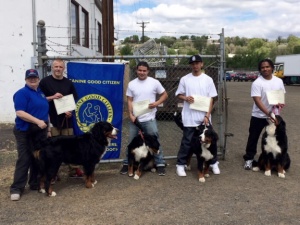
Photo: Jan Logan awards the CGC rosette to new CGC title holder “T-boldts Stealing Bases Stealing Hearts” owned by Becky & Chuck Wootten (Breeder Sherry Boldt)

Posted in Uncategorized | Tagged , , , | 2 Comments

Reinforce or Reassure?

Recently, I took a flight from Atlanta to New York City.  I got on the plane and noticed that the person in the seat next to me had a black carry-on bag under her seat. Not long after the plane took off, there was a loud, ear-piercing, “YIP!” from the bag.

travel bagThe dog owner quickly pulled the bag into her lap, unzipped it, put her hand inside, and starting talking to her dog. “I’m here,” she said. “You’re okay.” The dog quieted and the bag was zipped and placed back under her seat.

A short time later, there was another startling “Yip!” Again, the dog owner immediately scooped up the bag, unzipped it, and as before, petted the dog and told him he would be okay.

At this point, the behavior analyst in me started thinking, “Lady, please don’t do that every time the dog yips or you will shape yipping and we will be in for a very long plane ride.”

I’m so glad I kept my mouth shut and decided to watch and see what happened. The dog was fine.

How is it that the owner didn’t shape up yipping behavior? I believe it had to do with the function of the behavior. If the dog had been yipping for attention and the owner reinforced it, we would have probably experienced the long yipful plane ride. But this dog seemed to want to know his owner was still there. Once she touched him, he was fine.

As dog owners, we need to know when to reinforce and when to reassure our dogs.

Posted in Uncategorized | Tagged , , | 7 Comments

When Should You Start Training? The Answer May Surprise You!

As the final installment of this week’s blogs on puppies, here’s one more bit of information from our book, AKC S.T.A.R. Puppy: A Positive Behavioral Approach to Training.

cover STARIt used to be that trainers and veterinarians recommended that puppies begin training classes as soon as they were old enough to have all of their vaccines and boosters. What this meant was that some puppies didn’t get to class until they already had behavioral issues and were headed down the path to a problem that started in the Critical Period of Socialization or Fear period.

As a result, veterinarians, veterinary technicians, animal behaviorists and many trainers now recommend that puppies (who do not have health problems) begin classes as early as 7 to 8 weeks. 

The American Veterinary Society of Animal Behavior (AVSAB) states: “In general, puppies can start socialization classes as early as 7-8 weeks of age. Puppies should receive a minimum of one set of vaccines at least 7 days prior to the first class and a first deworming. They should be kept up to date on all vaccines throughout the class.”  The idea here is that inadequate socialization during the first two to three months of the puppy’s life can result in behavioral issues (including fears, phobias, avoidance, and aggression) that extend well into the dog’s life.

While there may be some breeders and trainers who disagree, the current thinking in the medical and behavioral world is that the benefits of attending classes early outweigh any possible health risks.

In AKC S.T.A.R. Puppy classes for young puppies, instructors will tailor the instruction to meet the needs of younger puppies. Most of the class in the beginning will be geared at play and socialization. By the time the puppies graduate 6 weeks later, they are developmentally ready to begin learning additional new skills.

For your copy of AKC S.T.A.R. Puppy: A Positive Behavioral Approach to Training, go to http://www.dogwise.com

Posted in Uncategorized | 5 Comments

Submissive Urination

On Monday, we talked about the Siberian Husky Puppy who urinates when meeting new people. Many puppies will outgrow submissive urination, but here is a behavioral approach to handling the problem that will help you socialize your puppy.

siberian and girlProblem: the puppy urinates when people in public walk up quickly and reach out to pet him.

What you do: Get a helper to work with you. To begin, this can be a friend or family member.

1. Helper slowly approaches up to about 10 feet away from puppy and stops. If the puppy did not urinate, go to the next step. At any point the puppy urinates, you need to back up to the previous step. For example, if the puppy urinated when the person was 10 feet away, try this step with the helper 15-feet away.

2. Helper approaches and gets 5 ft. away from puppy and stops. Did the puppy urinate? If not, repeat this with 3 ft., then 1 ft. away.

3. The helper is now 1 ft. away. Have the helper hold out her hand and offer the puppy a treat. While the puppy is eating the treat, the helper touches the puppy on the side, then removes hand. If the puppy is not willing to take food from a stranger, try a toy.

You can also do this behavior plan without the treat or toy, but treats are good distractors and often result in faster progress.

Finally,

  1. Helper approaches, offers treat, places hand on puppy, and pets.
  2. When the puppy can do this with a familiar person, bring in a new helper. Someone from your AKC S.T.A.R. Puppy class would probably be delighted to help you.
  3. Vary the places where you do this—at class, in the park, as you take your puppy for a walk in your neighborhood. You can also vary the position of the helper. In the beginning, the person may squat down when close to the puppy and over time remain standing.


Posted in Uncategorized | Tagged | 1 Comment

Tinkle, Tinkle, You Need S.T.A.R.

One of my friends has the sweetest little Siberian Husky puppy. He’s 5 months old now. “What do I do?” she said. “When I take him for walks and we meet someone, he gets so excited he tinkles.” Yes, that’s my friend, and she said, ‘tinkles.’

puppy peesWe’ve given advice on how to handle this problem from the AKC S.T.A.R. Puppy book before. It’s time to do it again to help this darling, blue-eyed pup.

From  AKC S.T.A.R. Puppy: A Positive Behavioral Approach to Training:

Submissive and Excitement Urination: Whoops!                                                            

Submissive urination. With puppies, submissive urination usually happens when someone reaches out to pet the puppy, someone leans over the puppy to pet it or greet it, or when an owner returns home and the puppy is excited. While this behavior mainly occurs in puppies, submissive urination is also a problem for some adult dogs.

Submissive urination happens with dogs or puppies who are submissive. These are puppies who often squat to urinate or roll over on their sides or show their bellies when greeting an unfamiliar person.

Punishing submissive urination, even if only with a loud verbal reprimand, will make the problem worse. Some puppies will grow out of submissive urination and others will need a behavioral intervention.

Excitement urination. Excitement urination is different than submissive urination. This occurs when highly excitable dogs lose control of their bladders during activities that involve social stimulation or put them in a state of arousal (i.e., heightened reactions). Excitement urination can occur during very active play.

If your puppy urinates when excited, someone new approaches for petting, or you enter a room, here are some tips:

  1. Never punish this behavior by hitting the puppy or yelling—this will make the problem worse.
  2. Make sure you give your puppy plenty of socialization and ongoing exposure to new people, places and things. An AKC S.T.A.R. Puppy class is a great idea.
  3. Identify the stimuli that cause the submissive or excitement urination. Observe very carefully to determine the conditions under which this happens:
    1. Is it when a stranger approaches for petting?
    2. When you come home after being gone?
    3. When you enter a room where the puppy is after she has not seen you for a while
    4. When someone stands over the puppy to pet it?
    5. When you are playing very active games?
    6. When the puppy gets ‘wound up’ during active play?
    7. Once you’ve identified a situation that is clearly a problem, set up training sessions  to work on this.In the next blog on Wednesday, we’ll show you what to do in training sessions.
Posted in Uncategorized | Tagged , | 3 Comments

Camellias and Dandie Dinmonts

More than ready for spring, I decided to visit Maclay Gardens in north Florida to spend a few hours among the camellias and azaleas.

Frank Houser cropMaclay Gardens, now a state park, was the winter home of wealthy New York banker and financier Alfred B. Maclay and his wife, Louise Fleischman.

On more than 300 acres with huge oaks, pines, and dogwoods, Maclay Gardens boasts one of the country’s largest camellia collections.

I thought the day was going to be all about flowers. And then I went into the modest winter home of the Maclays and saw it…the glass case of AKC dog show ribbons from 1912. It turns out that Alfred Maclay was a dog show exhibitor, and he was an AKC judge.

DandieMaclay bred Dalmatians and Greyhounds for a short time, but as Mrs. Maclay said, “Dandies were always his first love. We always had a Dandie in the house.”  Maclay liked the breed because he considered it a real terrier, an earthdog that was strong, a good hunter, and very faithful.

Posted in Uncategorized | Tagged , , | 5 Comments